home

Ken Zuckerman.com April, 2007

Radio Interview

In July 2006, Steve Tortorici, a radio programmer based in Florida, recorded an interview with Ken Zuckerman for a series entitled “The Artist Files.” It can be found at www.wuwf.org

To listen to the radio interview please click here:


Meeting: Two Worlds of Modal Music

Meeting Cover

To listen to a sampler of this CD please click here:

To order this CD at Amazon.com please click here.

To order this CD direct from Ken Zuckerman.com please click here.

Reviews

“First it seemed impossible, then even logical and finally… almost obvious: two traditions of modal music, North Indian and European medieval, became merged.” Basler Zeitung, Switzerland, Feb. 2003

“Two Worlds of Modal Music - one of the most remarkable examinations coming out of the Schola Cantorum in Basel is the fortunate meeting between American Ken Zuckerman and the brilliant medieval scholar/ performer Dominique Vellard… one of the most incisive cross-cultural efforts ever. .Robert Aubry Davis, Millennium of Music, May 2004

“During the evening the two hemispheres came closer. The love songs of Jehan de Lescurel flowed into a thrillingly played Raga Manj Khammaj. Finally the Sephardian ‘Ven querida’ and Hildegard von Bingen’s ‘O splendissima gemma’, movingly interpreted by Vellard in a high, clear and sure tenor voice, merged with an alap in Raga Bhairavi, in a unity of incredible beauty that made the question of cultural differences completely superfluous!” Basellandschaftliche Zeitung, February 2003 (more…)

Lutes of the World - Program Notes

Improvisations on Sarod, Medieval Lute, Oud and Dhotar

This performance gives listeners a rare opportunity to hear a variety of lutes from the East and West. Although their sounds, shapes, sizes and playing techniques vary somewhat, these four members of the lute family are all united by a common musical thread – mode. Monophonic modal music, which is at the heart of many eastern classical traditions, also played an important role at various stages in the development of western art music, particularly during the Middle Ages.

Program from Feb. 2006 in the Purcell Room in London (more…)

Instruments

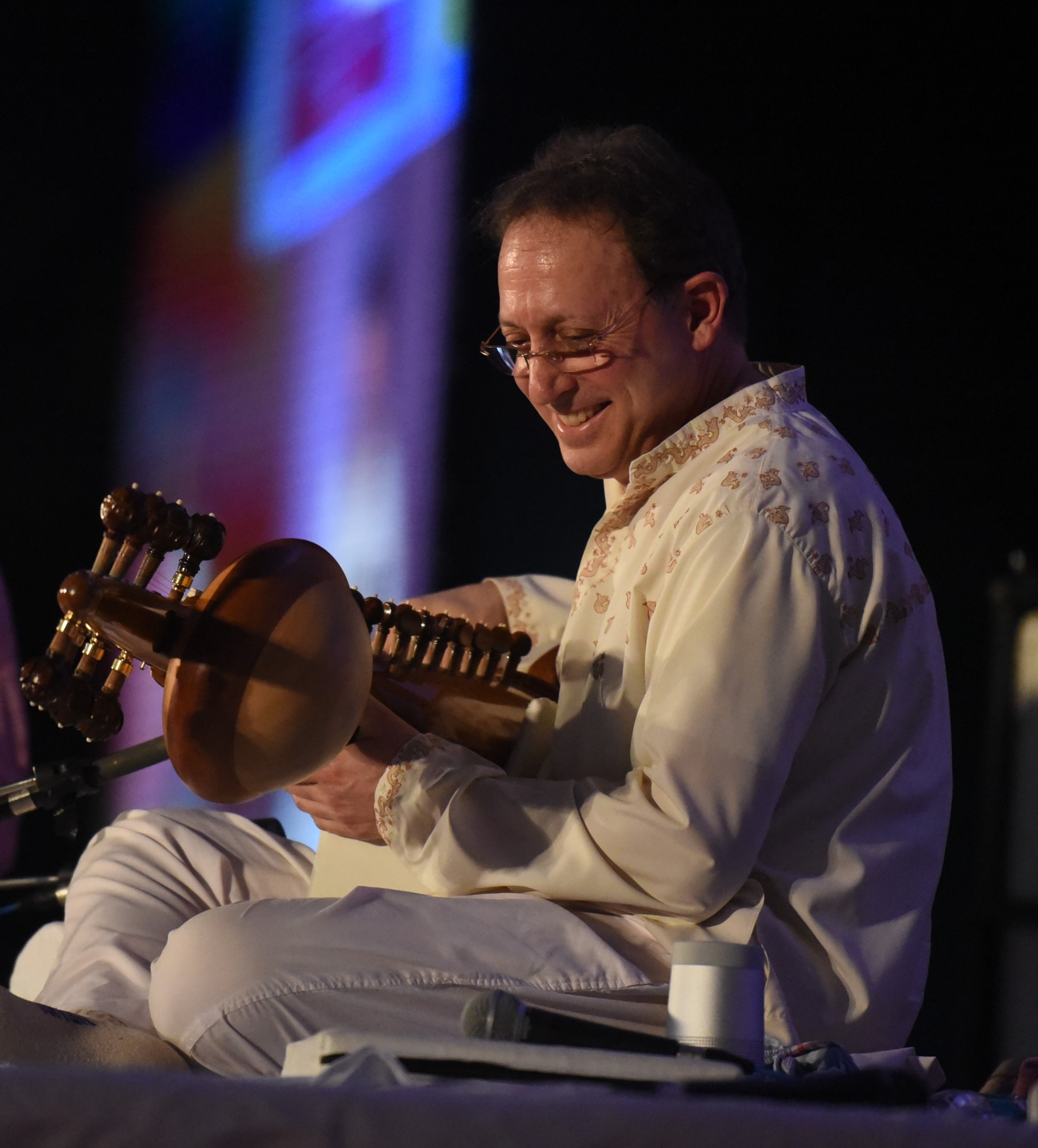
The Sarod

The representation of the Sarod type of veena has been found among the 1st Century carvings of the Champa Temples (Madhya Pradesh) India. Also the archeological remains of Rupar (2000 B.C.) and sculptural representations of Gandhara (6th Century B.C.) show instruments which resemble the Sarod, having 3 or 4 strings. However, apart from these early depictions, it is almost impossible to trace the precise evolution of the sarod over the course of many centuries. Still, it is generally agreed to that the sarod - in its present form - is at least 100 years old. During this time, many important changes in the instruments features were made by Ustad Ali Akbar Khan’s father, the late Padmabibhushan Dr. Allauddin Khan. The body of a sarod is of teak or mahogany, the belly is covered with goat skin and the unfretted finger board is metal. The latter feature allows the playing of meend (glissando) and the subtle gamak (shakes) which typify sarod playing. The instrument has twenty five metal strings, ten of which are played with a plectrum made from a coconut shell. Four strings carry the melody, three are tuned to the tonic and serve to accentuate the rhythm, and three others are tuned to the dominant notes of the chosen raga. The remaining fifteen are sympathetic strings, which resonate when the corresponding notes on the main strings are played. A metal gourd increases the resonance as well as to help keep the proper balance of the instrument.

The Tanpura

The tanpura is the essential drone instrument in all forms of classical North Indian Music. It has between four and six strings and is found in a wide range of sizes. The function of the tanpura is to sound the tonic repeatedly throughout a performance so that both the performer and the listener are always aware of the basic notes of the raga.

Tabla

The Tabla is the most popular drum of North India, and is in fact a set of two drums. The right hand drum (tabla) is tuned to the tonic of the solo instrumentalist or vocalist; the left hand (banya) acts as the bass and is capable of many tones, which can be varied by the pressure from the base of the left palm. Between the straps and the drum bodies are pieces of wood by which the tension can be altered with the aid of a tuning hammer. It is possible to produce a great variety of sounds from these drums, and every possible sound is represented in a vocabulary known as bols, by which expert tabla players are able to recite any composition that can be played.

North Indian Classical Music

“Ken Zuckerman’s selection was the pentatonic Raga Durga. His alap-jor was all it should have been, with the raga building up gradual by tier. There were long, smooth, effortless glides and malleable meends. The alap was reposeful, tranquil, and the result of deep, thoughtful playing, The gat in jhaptala was the forum for Ken to display his profound grasp of both swara and laya. The five notes were varied infinitely in a staggering range of permutations and combinations, peppered liberally with interesting tabla solos. The tricky teentala gat had taankari as its focal point, with the jhala at supersonic speed.” Bandana Malhotra, Hindustan Times, Feb.2, 1996

North Indian classical music is one of the most highly developed art music’s in the world. Partaking strongly of improvisational elements, the structural framework of the music is provided by a system of melodic patterns called ragas and of rhythmic patterns called talas. Within the framework, the performers must create the musical fabric at the moment of performance.

Following tradition, the musician doesn’t perform a set program, but rather plays different ragas as inspired at the moment. The choice of raga is not usually a matter of whimsy: in accordance with centuries old philosophical traditions, certain ragas are considered to be appropriate to specific times, seasons of the year, and even states of mind.

Ragas are not to be confused with the Western notion of “scales”, for while each raga has a characteristic pitch structure, much more is implied. The order in which the notes of the raga are introduced, and the manner in which the raga itself is revealed and unfolded are all extremely important. So, also, are matters of ornamentation, pitch alteration, and melodic structure. Historiclly speaking, one actually finds a close correlation between the concept of raga and the early western western church modes.

Although notational systems exist, the tradition is largely an oral one, passed on by each master to students. Performances are appreciated by the audiences in many of the same ways as jazz improvisations: that is, performers are expected to demonstrate extensive knowledge of the traditions of the individual raga (in the same way a jazz musician is expected to know “the changes”). Nonetheless, in both traditions, the performer is admired when able to cast some new light on the familiar: it is the ability to honor the integrity of the raga while doing so in an intensely personal way that wins the greatest esteem.

Form
The basic form for the interpretation of a raga is made up of four parts, ALAP, JOD, JHALA and GAT .

Alap
This is a slow introduction where the performer contemplates the raga note by note, composing phrases, at first quite simply, with the two or three notes nearest the tonic, but gradually becoming more and more complex as he extends through the first octave and then later, over the whole range of the instrument. The alap is performed “ad libitum” rather like a Western cadenza, deriving momentum from the emphasis in the developing phrases. Much use is made of microtonal inflections, ornamentation and glissando. The artist, through his use of these means of expression, reveals his understanding of and sensitivity to the raga he is playing. A truly creative musician is always trying to draw out of a raga some hitherto unseen facet, by way of his improvisation.

Jod / Jor
When the artist feels that he has completed his exposition of the raga through the alap he introduces a rhythmic pulse in to the music, starting again by playing short phrases against his regular striking of the drone strings. As the rhythmic dimension enters the music, the improvisations become more and more extended, eventually with very fast staccato passages called “tans”, full of rhythmic subtlety and requiring considerable technical virtuosity. After several stages of increasing the tempo, the performer can either finish this section or go on to one final movement.

Jhala
Jhala is a section where the artist performs a variety of virtuosic rhythmic patterns utilizing the “chikari” strings (high pitched drone strings). Depending on the performance, the jhala can either be the culmination of the first part (without tabla accompainment), and/or the climax of the “gat” portion.

Gat
This movement is really in “Rondo” form with the main subject being a previously composed motif (usually traditional), which is set to a recurring rhythmic cycle called a “Tal”. The tabla player, whose main function is to mark this “Tal”, accompanies the melody instrument to the end of the performance. As with the western Rondo where the main theme returns after each variation, the Indian performer, having improvised for a few cycles will return either to the beginning of the theme, or to the first beat (the “Sum”) of the new cycle (not necessarily the same). The theme, or “gat”, also serves as a time keeping pattern and the main performer may repeat the gat for several cycles while the tabla player improvises. Actually, it is usual for this whole movement to consist of two gats, one slow and one fast. Near the end of the performance the melody instrument makes a transition into jhala again to bring the performance to a climax.

Tala
Talas are the rhythmic frameworks around which Indian music is composed and improvised. Each tala has a constant number of beats, organized into phrases. Sometimes the phrases are equally divided (ie. Teental, 4-4-4-4), and sometimes they are of unequal lengths (ie. Dhammar 5-2-3-4). Both soloist and accompanist are required to always be aware of the returning of the first beat of the tala. Although in the midst of a composition or improvisation it is permitted (and even encouraged), to emphasize beats and phrases contrary to the framework of the tala, all variations must eventually return to the first beat of the cycle. This moment of return provides much of the exitement of Indian music and gives the musicians extensive scope to show their virtuosity and creativity.

Knowledgable audiences, both in India and the West, are able to follow the movements of the talas and thus, have an increased awareness and appreciation for the musicians’ ability to artistically develop their improvisations within the structures of the rhythmic cycles and return to the first beat. But even uninitiated listeners can sense the moments of rhythmic and melodic return, where all the elements seem to meet again. Many times these moments bring an added thrill to the music and along with it, even spontaneous applause from both experienced and first-time listeners alike.

Some of the more common talas:

TEENTAL
16 beats, 4-4-4-4

DHAMMAR TAL
14 beats, 5-2-3-4

JHAPTAL
10 beats, 2-3-2-3

EKTAL
12 beats, 2-2-2-2-2-2

RUPAK TAL
7 beats, 3-2-2

CHACHAR
4 beats, 3-4-3-4

KEHARWA
8 beats, 4-4

DADRA
6 beats, 3-3

IMPROVISATION IN MEDIEVAL MUSIC

The following is an excerpt of two articles that can be found in publications from Amadeus Verlag / Winterthur:

German version - “Improvisation in der mittelalterlichen Musik”, Basler Jahrbuch für Historische Musikpraxis Basel / 1984
English version - “Improvisation in Medieval Music”, Improvisation Winterthur / 1995

——————————————————————————–

Recent research has shown that improvisation played an important role in Medieval music. The study of both theoretical treatises and the music sources themselves, indicates an extensive non-written, improvised tradition, existing alongside the composed, written repertoire. In particular, the 14th-century instrumental collections of estampies and istampitas give us a diverse and instructive glimpse into the medieval world of mode and improvisation. In showing a very consistent conception of modal composition and a diverse employment of improvised structures, they invite us to expand our understanding of the medieval art of melody making.

In attempting to recreate the practice and pedagogy of medieval improvisation, it has been necessary to re-evaluate many of the basic conceptions that have become deeply ingrained in the world of Western classical music education and performance. This has not only involved a different look at the basic materials — i.e. notation, compositions, etc. — but also a look to other musical cultures. In particular, the strictly controlled practice of modal improvisation in North India has provided important clues as to how an extensive unwritten repertoire can evolve.

In addition, it is necessary to take a closer look at the elusive term “improvisation”. Although it is a common word, used to describe a variety of experiences in our everyday lives, its specific meaning in relation to music is often times vague and invites misunderstandings in both musicians and listeners alike. This is easy to understand once we realize that although some aspects of improvisation can be analyzed and quantified, much of the essence of both its internal workings and external “charm” remain, if not completely subjective, at least very personal and rather difficult to put into words. Musicians sometimes describe the process as being mysterious, unconscious, spontaneous, and many are not quite sure why it is sometimes effortless, other times difficult, and in any case, impossible to maintain for extended periods. But on the other hand, almost all musicians acknowledge that it requires a long and extensive practice in order to become a fluent and intelligent improviser. And in general, although some western musicians have had experience with improvisation, it remains nevertheless on the fringe of western music practice and education. This is easy enough to understand since there is little place for it in most all of the repertoire a classically trained musician ever performs. But in the field of early music, where improvisation is know to have played a much larger role, the lack of knowledge and experience is felt much more acutely. Thus the questions emerge, What was the nature of improvisation in earlier times? How were musicians trained in this art? and, Can one ever hope to incorporate this “spontaneous” practice into the “reconstruction” of medieval music?

One of the first things we notice about the teaching of music in eastern cultures is the importance of the teacher. The transmission of music in unwritten, improvised traditions is completely dependent on a close and long-term relationship between the teacher and student. The teachers’ role is not only to instruct in technique, interpretation, composition and improvisation, but also to literally pass on an entire repertoire to the student, without relying on written materials. Thus it is not uncommon in a tradition like classical Indian music, for an apprenticeship to last for over 20 years! The nature of this kind of long-term relationship demands a student to make many adjustments in attitude, not the least of which is a sense of patience that in order to learn the repertoire and become a master of improvisation, it is necessary to spend many years of training, carefully following the example of the teacher.

Another problematic aspect of this kind of music training is the necessity of learning all of the music by ear and retaining one’s entire repertoire in the memory. This is something particularly difficult for us to accept, coming from a tradition where even a performance repeated numerous times is usually not memorized. And this is also an excellent example of an idea which cannot be understood at all without experiencing. For until one learns a large amount of music by ear, and at the same time, commits it to memory, it is impossible to imagine having instant access to so much material while improvising. Even using the somewhat crude example of the computer can illustrate this. Anyone who has had experience with these machines knows how fast the internal memory of a computer functions, as opposed to how much slower it is when one has to put in a separate diskette for each file. In the same way it is easy to imagine how much faster one could access an entire repertoire if it was in the internal memory (the brain) instead of on diskettes (music notation). Even many students of Indian music rely extensively on written notations and in general do not memorize half the compositions which are taught to them. The teacher, while not expressly forbidding the taking of notes, often gives warnings about the consequences of this practice. “Very good! Now after ten years your notebooks are full of thousands of compositions I have given you. But what do you really know? Remember, you can’t bring your books with you onto the concert stage.” My experience of the truth of this statement has left me with the conviction that without learning a given repertoire in this way, it is useless to think that one can develop the ability to improvise fluently and spontaneously in it. For those taking up a study of early music, this is a difficult prerequisite to accept, especially for those who have already received an extensive training in western music.

One of the most difficult problems that faces a western student wanting to learn music in the “classroom of the east”, is the unwillingness to accept the limits of the participation of the intellect during the training. This is not to suggest that a mature player does not think at all when he improvises. On the contrary, there is an important place for active thought while improvising and composing in the moment. However, there is a general tendency for us in the “western world” to over-analyze and to attempt to understand aspects of music making with the intellect which must be first understood at other levels, such as the motor centers and emotions. It is a curious contradiction. On the one hand, we don’t seem to mind at all giving a child all the time he or she needs to learn to walk and run without any intellectual instructions, nor does the child ask for any. On the other hand, when it comes to a beginner in music, whatever his or her age, we insist on explaining many things which can only be understood and executed after much practice. Not only does this intellectual approach actually slow the more important process of intuitive and automatic learning, but it interferes with the students’ developing higher levels of listening and observation. Especially at more advanced levels of learning, it is precisely the moment of not understanding which should sharpen the students’ power of listening and observation - and not simply the impulse to formulate another question. My teacher has struggled with this characteristic in his students for years. At one point, in his usual way of “improvising” analogies to get a point across, he said: “It is really so simple. Why all this talk? When you eat, you eat. When you sleep, you sleep. So - when you learn music, learn music! Why talk?” For most of us, these true, simple and practical words are very difficult to put into practice.

The understanding of mode may be the most important single skill for a musician learning to improvise in Medieval music. It is also an area which is most often completely lacking in the training of musicians today. Although there is an extensive literature in which mode plays an important role, we have very few indications of how mode and modal improvisation was taught during the Middle Ages.

(…)

In Indian music thousands of modal frameworks exist under the general term raga. Many times there are a large number of ragas which share the same “parent” scale - like dorian - but each one has its own distinct identity and rules for composition and improvisation.

(…)

One of the most serious problems in improvising medieval or for that matter, any music, is that the basic rhythmic and melodic building blocks are not an integral part of the musical consciousness. All of these elements must be second nature - automatic, so to speak. If the mind must be concerned with all these small details, then it cannot be free to listen and develop a larger structure. This phenomenon can be compared to language: if we try to think separately of every word as we are speaking, we experience how difficult it becomes to keep a larger concept clearly in mind. Further, if we had to be aware of every single letter of each word, it would be practically impossible to recite a sentence, let alone improvise the re-telling of a story! For a musician trying to improvise in the medieval style today, the problem is extreme. Not only is he cut off from the roots of the style, but often times he has already been exposed to and performed in repertoires as diverse as those of the renaissance, baroque, classic, romantic, avant-garde, pop, rock, etc. When it comes time to improvise, all of these styles and formulas tend to get mixed up and the resulting improvisation has no identity at all!

(…)

On the subject of permutations, there are an almost endless number of ways to approach the multi-faceted subject of improvisation - stylistic, psychological, motor, aesthetic, etc. This variety is in fact, quite in tune with the subject itself! What has been intended here is an introduction to an approach developed somewhat by chance - an encounter between one musicians’ general fascination with the subject of improvisation, and his specific investigations into the musical worlds of India and that of the Middle Ages.

Kenneth Zuckerman
February, 1994 Basel

CD Purchase Information

There are several ways to purchase Ken’s CD’s - online retailers, digital downloads and direct from this website. Please click on the CD covers to see the purchase options for each title.

If you would like to order 1 or several CD’s directly from Ken Zuckerman.com, you can do so in this way.

Just send us an email at orders@kenzuckerman.com with your postal address and the number of CD’s you would like to order. Prices vary according to Country but in all cases, you will benefit from significant discounts if you order multiple CD’s. In addition, if you order 3 CD’s you will receive a free CD of “Hemant - an evening Raga”!

Nature of Ragas - Ragas of Nature

Nature CD cover

A collection of short vignettes, ideal as an introduction to Indian music.

To listen to a sample from Track 16, please click here:


To purchase this CD please follow one of the links below:

1) Direct from CD Baby (best for USA customers). Now also available as an MP3 download!

2) Direct from itunes as a digital download.

3) Direct from Ken Zuckerman.com (best if you wish to purchase this along with some of Ken’s other CD’s that are not available yet online)

**You can listen to samples from most of the CD tracks at CD Baby!

Review

Excellent sarod performances, connecting Indian classical music to the natural world.

The connection of Indian ragas to specific seasons and times of the day has long fascinated Western listeners. It’s an intriguing extra-musical dimension that immediately conjures up the scents and moods of another culture. However, it is unclear how literal these connections are and not all Indian musicians will make a simple link for example, between the ambience of early morning and a raga specified for performance at this time. Indian music is not programmatic in that straightforward sense - often the connections are more abstract and subtle

On his new CD, though, American sarod player Ken Zuckerman makes quite specific links between particular ragas and elements of nature, hence track titles such as ‘Morning Mist’, ‘Awakening’, ‘The Sun’s Welcome’, ‘Passing of the Day’, ‘Twilight’s Secret’ and ‘Soothing Rain’. In his view ‘the classical ragas have an almost magical power to bring us in closer contact with the natural world’.

Zuckerman is the accomplished student of sarod maestro Ali Akbar Khan and the latter’s influence permeates the album both in sound and aesthetic outlook (and because several of Khan’s original compositions are included). Zuckerman’s playing is impressive throughout, particularly in the alaps or unmetered introductions to the ragas where the delicate mood of each piece is explored in detail. He is accompanied by Anindo Chatterjee, one of India’s most renowned tabla players.

The liner notes, by Zuckerman, are detailed and informative, revealing to the listener the fascinating meanings of this music. Gerry Farrell

_________________________________________
Nature_ Ken and Anindo

NATURE OF RAGAS - RAGAS OF NATURE
- A collection for times, moods and seasons (more…)

The Global Impact of Indian Music

Perspectives from a student, performer, teacher and composer

The seminar entitled “Globalization and Indian Music,” which took place in Mumbai in January 2002, under the auspices of the Sangeet Research Academy, provided a forum for musicians, teachers, members of the music industry and representatives from government agencies to discuss the significant impact that Indian music has had around the world.

During the discussions there appeared to be some ambiguity as to the actual meaning of the word ‘globalization’, especially since one of its common uses today is associated with western economic expansion throughout the world at the expense of local economies and cultures. As a result, this article will use the phrase ‘global impact’ to describe the effect of Indian music on the lives and interests of music lovers around the world.

On this subject there is no ambiguity: Indian music has indeed had an extensive impact on music lovers all over the world. Having myself been deeply affected by this impact, I wish to describe the events and experiences during the last thirty years that have helped shape my musical life and career. By citing examples of my own experiences as a student, performer, teacher and composer, I hope to draw attention to several aspects of the global impact of Indian music.

There are four general areas on how this global impact affected my musical development:

I) As a curious music student in search of a style, who meets a master of an ancient musical tradition.

II) As a western performer of Indian music - both in and outside of India.

III) As a music teacher, integrating Indian music pedagogy into the western music classroom.

IV) As a composer exploring the contacts and contrasts between Indian, western, and other music traditions of the world.

I) A curious music student in search of a style meets a master of an ancient musical tradition.

I was fortunate enough to grow up in a place and time, as well as in a family, that encouraged me to follow my curiosity and musical instincts in listening to and experimenting with a wide variety of styles. From pop and rock’n'roll, to jazz, folk, classical and early music, I was able to get a taste of many styles. These I explored both vocally as well as on instruments: piano, guitar, cello and lute. I also happened to be at the right place at the right time, in the late 60’s and 70’s, during the great heyday of Indian music’s popularity in the West. And in 1971, I was fortunate enough to meet the renowned performer and teacher, Ustad Ali Akbar Khan. (more…)

A JOD OF TWO CULTURES

Indian Express - Weekend Edition
Bombay - Saturday, August 8, 1992

Ustad Ali Akbar Khan rates him as one of his most gifted disciples, while connoisseurs recognise in Ken Zuckerman’s felicity with the sarod the soul of his guru’s artistry. Sumit Savur in conversation with the internationally acclaimed Jewish-American sarodist, who has astounded audiences here and abroad with his mastery over the alien instrument. Ken Zuckerman was born to Russian-Jewish parents in America. In 1971 he was swept off his feet by a chance encounter with sarod maestro Ustad Ali Akbar Khan, and has been his ardent disciple since. He directs the Ali Akbar College of Music in Switzerland, while also teaching music at the Music Academy, Basel.

Ken, how do you account for your interest in the sarod?.

It was not so much the sarod, as my fascination with Ustad Ali Akbar Khan, which eventually led me to California to try out a summer studying Indian music. In fact, I began my studies with the sitar. I switched to the sarod later.

Did you already possess a Western classical background?.

I knew classical music, but I was not a practitioner. It was a long-term background, not particularly classically focussed. I was more in to the lighter forms; played the electric guitar, rock’n'roll, the acoustic guitar, did a lot of composing in jazz and folk music. Indian music has such a broad spectrum of expression through its raag vistaar, bols, layakari…

Did you have any communication difficulties?.

Well, the Ustad always spoke to us in English and his accent was a bit difficult initially. He taught us step by step. That made the task of learning less daunting. The main accent was placed on singing. Khansahib led the class in singing and we were encouraged to follow first in singing as closely as we could and later repeat the tune on the same lines with our instruments.
The methodology of teaching was very direct; the terminology came as we went along. As most Indian music is taught by the ear, a general difficulty for most Western students is to give up the eye contact with the music sheet and cultivate the capacity to listen, commit to memory and develop the mental capacity to reproduce music from recollected lessons. It is an education in itself.

You certainly have assimilated our music very well. How many hours of riyaaz have you put in to attain your level of proficiency?.

Over the years, it has been more intense. Having begun to learn as a young adult, I had to earn a living and as such I had to deny myself the opportunity to exclusively practise on the sarod. Next to my studies, I was always doing something: washing dishes, selling shoes or giving guitar lessons, so my riyaaz was always limited. In these 20 years I have put in the riyaaz of listening to my Khansaab and absorbing all I can. I know I have tried all I can to capture the essence of his style, though I still need to make myself technically more proficient in terms of tayyari.

Tayyari now seems to be the watchword. There is a marked tendency to show off possibilities with the instrument rather than the raga. You, however, seem to favour a quieter melodic line and almost studiously avoid the jazzy crescendo in the progression of the raga..

I have a tendency to go for the lyrical approach and as such my riyaaz has been slanted more on the alap and slow development of the vistaar. The mood of a raga is the essence in Indian music. This is what my Ustad taught us and demonstrated through his playing. If the fundamental melodic line if the raga is sketchy, mere tayyari or striving for speed will not give the desired effect. When I began coming to India, some of these young sarod players in Calcutta would laugh at me because I wasn’t playing very fast. Having learnt outside India, I am lucky I have been out of this vicious circle. (more…)

  • Recordings


  • Ragas d'equinoxe


    2 Worlds Modal


    Salon de Musique


    Nature of Ragas


    Modal Tapestry


    Hemant


    Live in Basel


    Lute Improvisations
    (soon available)