home

Ken Zuckerman.com May, 2007

Improvisation Workshops

Ken Zuckerman’s long-time research into the practices of improvisation in both western and eastern music have given him a unique perspective on teaching this subject. For example, his courses at the Music Academy of Basel on “modal improvisation” use the source material of Indian melodic modes (ragas) to initiate western music students into the techniques of improvisation. Students usually first learn these basic skills vocally and then later, apply them to their instruments

This work can also be presented in the form of workshops for music students who have had little or no experience with learning improvisaiton. In this case 1 or 2 day sessions are taught instrumentally, which enables the students to execute the basics more easily.

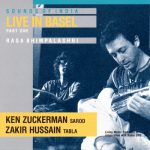
Live in Basel

Live in Basel cover

To listen to a sample from Track 1, please click here:


To order this CD direct from Ken Zuckerman.com please click here.

Review
India Currents / November, 1991

LIVE IN BASEL, Part One. Ken Zuckerman (sarod) and Zakir Hussain (tabla). Compact disc LMT CD3004, AAD, 62:40. Living Music Traditions Inc.

Master musicians make their mark on the world by leaving a living legacy behind. In the West, they do it with brilliant compositions and recordings. In India, they do it with shishyas or disciples who have been years and years in training. One such shishya is Ken Zuckerman who has been studying with Ali Akbar Khan for 17 years and now directs the Ali Akbar College of Music in Switzerland. He has recently performed with his guru in concerts in Bombay, New Delhi, Europe, and here in San Diego.

This recording of Raga Bhimpalasi (spelled Bhimpalashri here) is part one of an unedited live concert in Basel, Switzerland in 1989. Here Zuckerman’s sarod is accompanied by Zakir Hussain’s tabla. The second part consists of a powerful solo by Hussain, followed by Raga Jhinjhoti, and is available as a separate CD.

Ken’s rendition of this late afternoon raga is exemplary. It exceeded all my expectations. He has been recognized as one of the finest disciples of Ali Akbar Khan. After listening to this compact disc, I could not help agreeing more.

Zakir Hussain’s style of playing is aptly described as the “plucking of drumskins - both of the drums themselves and those of our ears.” As a student of his says, no one has been as successful in emulating musical notes on the tabla as he has.

The recording is of very good quality and the CD has been mastered AAD. The liner notes sound apologetic about a slight background noise during the opening minutes of the concert, but I didn’t even notice it. This CD is an outstanding example of Zuckerman’s prowess. He has four other recordings, some on CD and others on MC (I assume this stands for master cassettes). Go out and get them.

Mahesh Jethanandani India Currents

Live in Basel cover

Sounds of India. LIVE IN BASEL

Raga Bhimpalashri.
Alap, Jor 27:46
Gats in Teental (16 beats) 34:54

Recorded from a concert in Basel, Switzerland on March 19, 1989.
Co-sponsored by the Museum für Völkerkunde and the Indian Music Circle of Basel.
P & C 1989 Living Music Traditions in cooperation with Radio DRS.
LMT CD3004
Michael Koechlin - Editor
Jürg Jecklin - Recording Engineer

Hemant - an evening Raga

Equinoxe inside photo

The cover of the CD reproduces original artwork by Robert Feintuch. Mr. Feintuch is a New York artist whose paintings and drawings are exhibited in solo shows at galleries in the U.S. and Europe.

To listen to a sample from Track 1, please click here:


To purchase this CD please follow one of the links below:

1) Direct from CD Baby (best for USA customers). Now also available as an MP3 download!

2) Direct from itunes as a digital download.

3) Direct from Ken Zuckerman.com (best if you wish to purchase this along with some of Ken’s other CD’s that are not available yet online)

**You can listen to samples from most of the CD tracks at CD Baby!

Raga Hemant -an evening melody-

1. Alap & Jor
2. Gat in slow Jhaptal (10 beats)
3. Gat in medium Teental (16 beats)
4. Gat & Jhala in fast Etkal (12 beats)

Equinoxe inside photo

total time: 63 minutes

Digital Recording from a concert
in Gelterkinden, Switzerland on Feb. 5, 1995
CD mastering: Jürg Jecklin (more…)

Ragas d’equinoxe

Equinoxe inside photo

To listen to a sample from Track 2, please click here:


To order this CD direct from Ken Zuckerman.com please click here.

“Notes d’équinoxe” is a biennial music festival which takes place in Delemont, the capital city of the Swiss french Canton of Jura. Co-produced by the Swiss public Radio „Radio Suisse Romande / Espace 2“, the festival is dedicated to presenting musical traditions from around the world. During three consecutive days of performances and live radio broadcasts, music lovers of this region are treated to diverse musical expressions representing cultures from all continents.

The music:

Râga Bageshri Kanra
A specialty of Ustad Ali Akbar Khan, who has often performed and taught it, this raga is a blend of the evening raga Bageshri and ragas of the Kanra (or Kanada) family. Conveying moods ranging from joy to heroic and passion to pathos, it offers many possibilities for expression and improvisation. The highlight of the performance, Bageshri Kanra is first developed in a solo section by Ken Zuckerman. Following the traditional classical forms, it begins with a long non-rhythmic introduction (alap), followed by an increasingly rhythmic exploration of the important melodic motives of the râga (jor). In the following section, Anindo Chatterjee provides both accompaniment and solo improvisations in the rhythmic cycle of teental (16 beats), in both slow and fast tempi, culminating in the climactic finale known as jhala. .

Râga Jogiya Kalingra
A creation of Ustad Ali Akbar Khan, raga Jogiya Kalingra is a fasinating mixture of several ragas, with an emphasis on raga Jogiya, mentioned in reference to the yogis who begin meditating before dawn. It is a very special râga, played late at night, just before the first light of dawn and for Ken Zuckeman, it is this ambiguous expression of a “time between times” which contributes to its unique beauty.

Râga Bageshree Kanra (traditional, arr. Ken Zuckerman)
1. Alap – Jor – Jhala (21′11)
2. Ghat in tîntâl (28′58)

Râga Jogiya Kalingra (Ustad Ali Akbar Khan, arr. Ken Zuckeman)
3. Alap and ghat (11′14)

Ken Zuckerman: sarod
Anindo Chatterjee: tabla
Antonella Carollo: tambura

Producer : Luc Terrapon
Artistic director and text : Vincent Zanetti
Recording : Salle Saint-Georges in Delémont, 21 September 2002, by Philippe Hamilton during “Notes d’équinoxe”, a RSR Espace 2 and town of Delémont co production

The sarod
is a lute with a solid body hollowed out from a single piece of teak or rosewood. Its neck has a wide fretless fingerboard covered with metal, which allows extensive use of glissandi and other sliding ornaments, spanning more than an octave on each string. The main body of the instrument serves as a resonance chamber and is covered with a a goatskin, which supports the bridge. Similar to the Afghan rubab in its general shape, skin covering and use of sympathetic strings, the sarod is well documented in India from the 16th century Moghul courts. During the 18th century it acquired its now characteristic metal fingerboard and increased number of sympathetic strings.

Today there are two common types of sarod played throughout North India. One type is represented by artists like Amjad Ali Khan, having two rhythmic drone strings, four to five melody strings and sympathetic strings. The other type owes much of its development to Ustad Allauddin Khan andhas been made world famous by his son, Ustad Ali Akbar Khan. This instrument has an additional bridge, more sympathetic strings and is usually played at a higher pitch. Ken Zuckerman plays this latter type of sarod.

The artists:
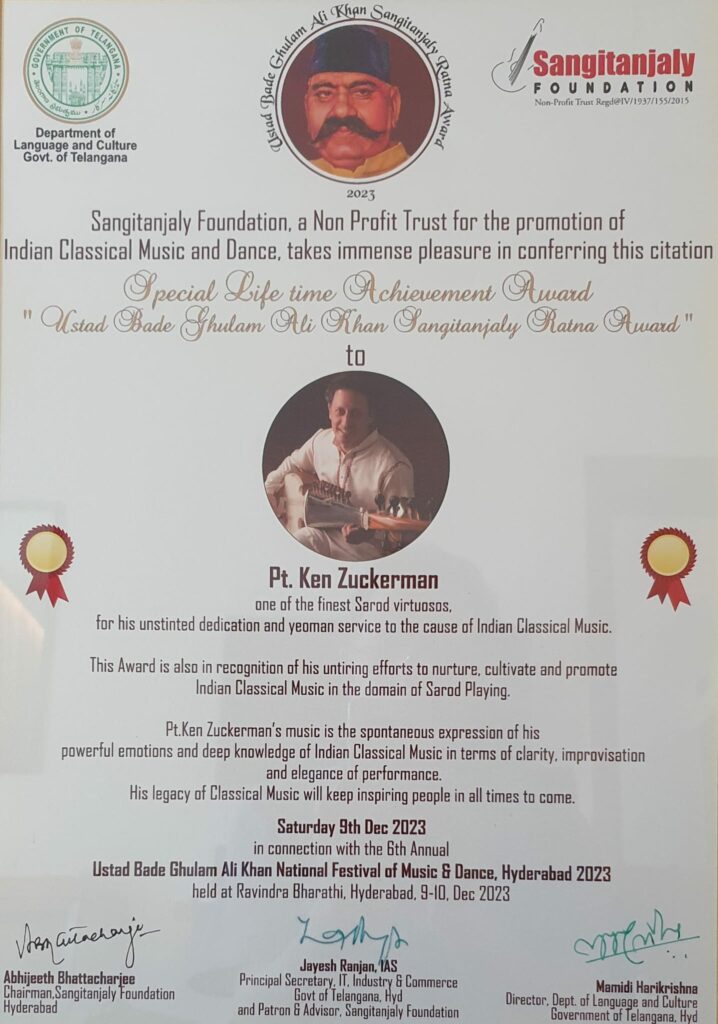
A disciple of the great Ustad Ali Akbar Khan for more than 30 years, Ken Zuckerman has had the privilege of accompanying his master on many international stages and is now among the recognized ambassadors of the art of the sarod, both in India as well as Europe and the United States. Director of the Ali Akbar College of Music in Switzerland, he also teaches North Indian classical music and Medieval music at the Music Conservatory of Basel . He regularly appears in concert with some of India’s most respected tabla virtuosos: Swapan Chaudhuri, Zakir Hussain, and as in this recording, Anindo Chatterjee.

Born in a family of musicians, Anindo Chatterjee began learning the tabla at the age of four. Two years later he became the disciple of the renowned performer/teacher, Padmabhusan Jnan Prakash Ghosh. This maestro was famous for his mastery of manyof the most important gharanas (traditional schools) preserving the art of the tabla -Ajara, Benares, Delhi, Lucknow, Punjab, as well as that of Farrukhabad, the style in which he had been brought up. This variety and depth of rhythmic knowledge now also characterizes the playing of Anindo Chatterjee and has made him one of the most respected and sought after tabla players in India today.

Available on CD and digital download from CD Baby! Modal Tapestry - Ken Zuckerman & Friends

Equinoxe inside photo

To listen to a sample from a live concert in Freiburg, please click here:


Order this CD Direct from Ken Zuckerman.com

Order this CD direct from CD Baby

KEN ZUCKERMAN & FRIENDS - MODAL TAPESTRY I

MODAL TAPESTRY I, composed especially for Germany’s SWR (southwest radio station), had it’s premiere performance at the cultural event “von vier bis vier” (from 4 to 4 - 24 hours of cultural events), which took place in Karlsruhe on May 27, 2000. The inspiration for the project came from Benno Trautmann, a member of the SWR Symphony Orchestra of Baden-Baden and Freiburg. With a strong interest in both classical western music and experimental and improvised styles, Mr. Trautmann asked Ken Zuckerman if it would be possible to create a composition for a mixed ensemble of musicians from diverse backgrounds, which would feature a blend of both western/eastern, and composed/improvised sections. Mr. Zuckerman, a composer and performer with extensive training in eastern and western classical music, readily agreed to the project.

THE COMPOSITION

Tapestry - a form of textile art, woven together and decorated with different kinds of threads. Modal Tapestry I is a composition that weaves together musical threads from diverse cultures into an artistic whole. The common thread, which exists in almost all music traditions - east and west - is mode. The concept of mode is at the core of many eastern music traditions - guiding a musician through the process of making melodies, both while composing and improvising. Mode was also a very important aspect of western art music during the Middle Ages and Renaissance. Although in later times (including our modern day period), the active use of modal ideas is less prevalent, the echo of this earlier practice can still be heard in many styles of music that we listen to every day.

The performance of Modal Tapestry I gives listeners a chance to hear modally conceived music in different contexts and configurations, from fully composed and arranged sections for ensemble to sections giving the musicians more space for solos and improvisation. The musicians taking part in the performance, coming from diverse countries like India, Japan, Australia, Hungary, Rumania, Italy, Germany and the USA, also add to the rich weave of the tapestry.

KEN ZUCKERMAN & FRIENDS
MODAL TAPESTRY I

Ken Zuckerman, sarod,
Anindo Chatterjee, tabla,
Christoph Grund, piano
Keiju Nakajima, guitar
Benno Trautmann, french horn
Jalalu-Kalvert Nelson, trumpet & percussion

Diego Pagin, violin
Susanne Kaldor, violin
Jean-Eric Soucy, viola
Markus Tillier, cello
Wolfgang Güttler, bass

Monika Hamlascher, tanpura
Annette Bauer, tanpura

A live concert recording of Modal Tapestry I, recorded at the Freiburger “Zelt” Festival in 2001.

MODAL TAPESTRY II
The Composition and performance was such a success that the Radio SWR commissioned Ken Zuckerman to compose “Modal Tapestry II”, which had its premier performance in Karlsruhe in 2002. Modal Tapestry II both developed musical concepts initiated in the first Modal Tapestry and also broke new ground.

Once again, the central concept of Modal Tapestry II is that melodic modes, existing all over the world in music styles of the past and present, can form a continuous thread which brings musicians, composers and audiences together in a special way. The juxtapositions of “composition / improvisation”, “ancient / modern”, “classical / popular”, “east / west” and “solo / ensemble”, all interacted to make Modal Tapestry II a unique listening experience!

Ken’s compositions and arrangements for Modal Tapestry II were complimented by pianist Christoph Grund, who contributed arrangements and compositions for the “classical” string section of the ensemble. In addition, guest appearances by medieval singer Dominique Vellard and Dhrupad singer Amelia Cuni added a vocal element to the performance. Modal Tapestry II had its Swiss premier at the Rheinfall festival in June 2007.

Photos for Download

Here are several photos at higher resolutions which can be downloaded. Please click on the link under each photo.

Ken Classic

Click here to open or download a high resolution version of this photo.

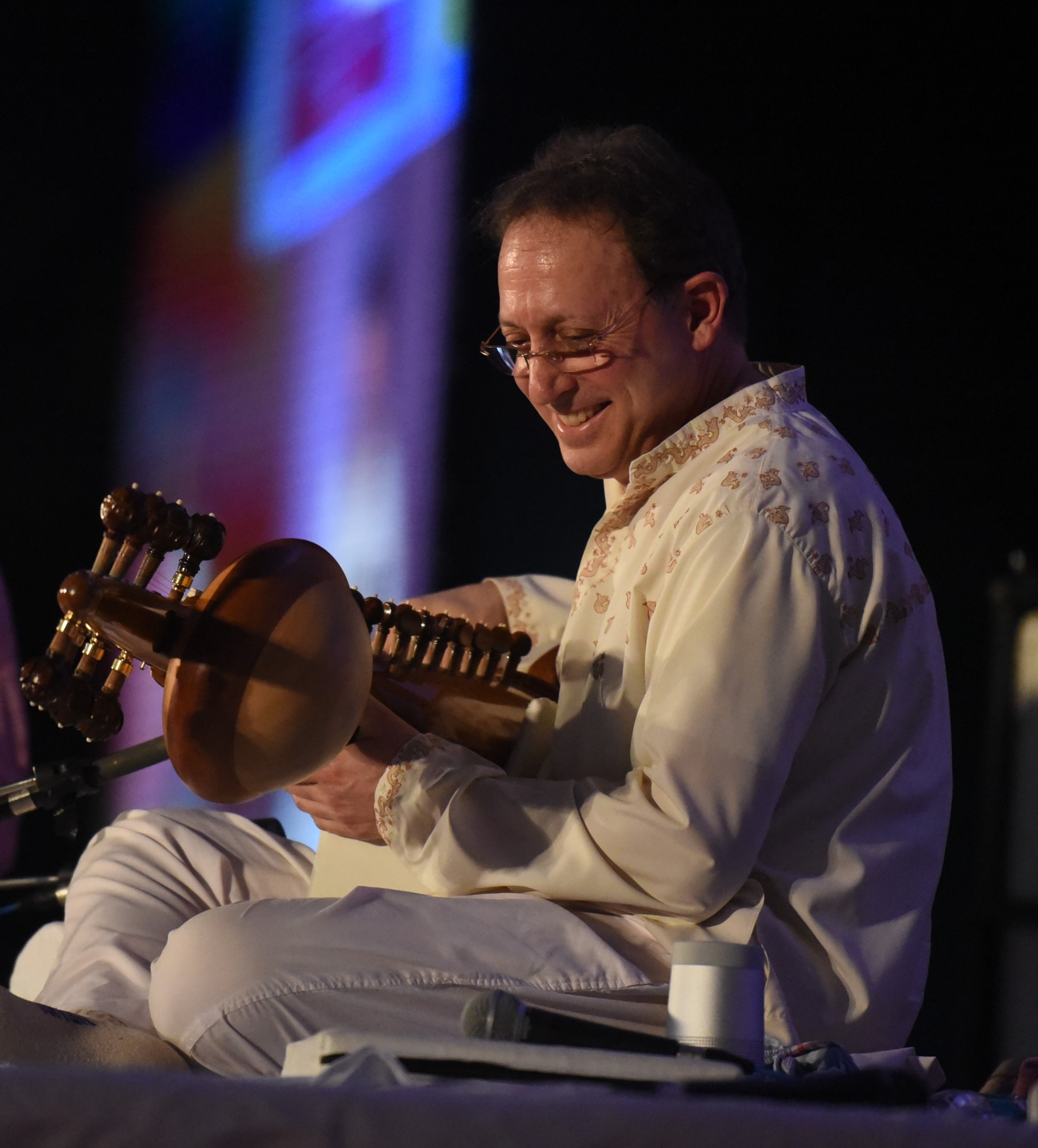
Ken smile 2

Click here to open or download a high resolution version of this photo.

Ken smile 2

Click here to open or download a high resolution version of this photo.

Sarod Recital - Program Notes

A recital of North Indian classical music

Ken Zuckerman - sarod, with accompaniment on Tabla and Tanpura

North Indian classical music is one of the most highly developed art music’s in the world. Partaking strongly of improvisational elements, the structural framework of the music is provided by a system of melodic patterns called ragas and of rhythmic patterns called talas. Within the framework, the performers must create the musical fabric at the moment of performance.

Following tradition, the musician doesn’t perform a set program, but rather plays different ragas as inspired at the moment. The choice of raga is not usually a matter of whimsy: in accordance with centuries old philosophical traditions, certain ragas are considered to be appropriate to specific times, seasons of the year, and even states of mind. (more…)

Meeting Two Worlds of Modal Music - Program Notes

Sample Program

Mode in D (Dorian)

Anonym - „Natali regis gloriae“ (Conductus, 12th c.)
Ken Zuckerman - Composition and improvisations in dorian mode
Gregorian chant - „Universi qui te expectant“ (gradual)
Traditional Indian - Raga Bhimpalashri

Mode in C

Traditional Indian Raga ‚Pahari’
Gregorian chant „Alleluia, Angelus Domini“
Traditional Indian * Raga ‚Manj Khammaj’- introduction
Jehan de Lescurel (beg. 14th c.) „Bontés, sen, valours et pris“ (ballad, lydian)
Traditional Indian ** Raga ‚Manj Khammaj’ - continued
Traditional Indian/Persian tabla/zarb - solo
12 Traditional Indian ** Raga ‚Manj Khammaj’ - conclusion

Mode in F (Lydian)
13 Traditional Indian ** Raga ‚Bihag’ - introduction
14 Raga ‚Bihag’ - continued and conclusion
15 Anonymous Istampita ‘Principio di virtu’
(source: London, British Library, MS Add. 29987)
16 Jehan de Lescurel „Douce amour, confortez moi“ (virelais)

Mode in E (Phrygian)
17 Sephardic „Ven querida“
18 Traditional Indian ** Raga ‚Bhairavi’
19 Hildegard von Bingen (1098-1179) „O splendidissima gemma“ -
20 Traditional Indian ** Raga ‚Bhairavi’
21 Raga ‚Bhairavi’ - continued
22 Raga ‚Bhairavi’ - conclusion

The musical traditions of the European Middle Ages and of North India, in spite of their many differences, have common roots going back far into the past. This can be seen especially in the organization of compositions according to the melodic modes. Internationally renowned specialists from the Schola Cantorum Basiliensis and of the Indian classical tradition here build a musical bridge between these cultures. Structure and improvisation, sensual melodies and complex rhythms, virtuosity and passion mark this fascinating meeting of two worlds! (more…)

Lute Improvisations

Lutes of the World

Ken Zuckerman - Medieval Lute, Oud, Sarod & Dhotar
Anindo Chatterjee - Tabla & Dupki
Keyvan Chemirani - Zarb

To listen to a sample please click here:


This CD is in production and is scheduled to be released in November 2007.

To order this CD direct from Ken Zuckerman.com please click here.

Lutes of the World

Improvisations on Sarod, Medieval Lute, Oud and Dhotar

This performance gives listeners a rare opportunity to hear a variety of lutes from the East and West. Although their sounds, shapes, sizes and playing techniques vary somewhat, these four members of the lute family are all united by a common musical thread – mode. Monophonic modal music, which is at the heart of many eastern classical traditions, also played an important role at various stages in the development of western art music, particularly during the Middle Ages.

Program from Feb. 2006 in the Purcell Room in London (more…)

Crossover & Fusion Projects

Ken Zuckermans’ thorough training in both western and eastern music performance, composition and improvisation, has also enabled him to participate in a wide range of both classical and experimental ensembles. He has been featured in Hesperion XXI’s Grammy Award nominated CD “Diaspora Sephardic”, and has taken part on various cultural crossover projects, including India Meets Persia, with Hossein Alizadeh, Madjid Khaladj and Swapan Chaudhuri, Modal Tapestry I, a Zuckerman composition for an ensemble of 14 musicians from western and eastern traditions, and Meeting Two Worlds of Modal Music, with the well known medieval singer Dominique Vellard.

For more information on these projects please click on the following links:

Hesperion XXI’s Grammy Award nominated CD “Diaspora Sephardic”

Modal Tapestry I and II

Meeting Two Worlds of Modal Music

Lutes of the World

  • Recordings


  • Ragas d'equinoxe


    2 Worlds Modal


    Salon de Musique


    Nature of Ragas


    Modal Tapestry


    Hemant


    Live in Basel


    Lute Improvisations
    (soon available)